Zelensky tells NBC 'thankful' US has unblocked intel sharing
Updated 2 hours ago

CENTCOM says US forces helped 1,000 vessels carrying 500 million barrels safely transit the Strait of Hormuz
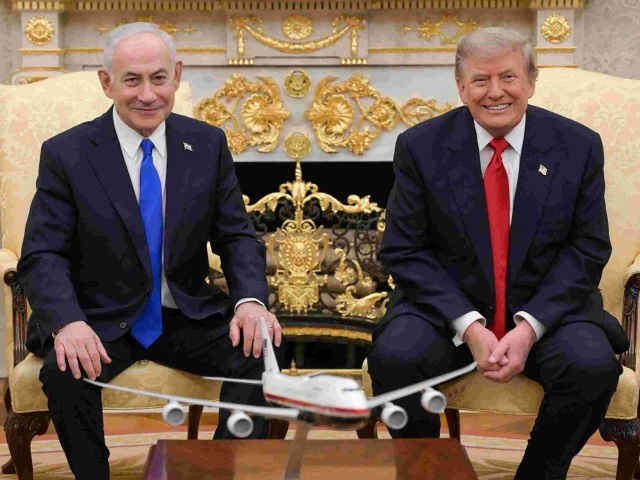
US President Donald Trump on Wednesday expressed concern about the severe repercussions of the Middle East war on global financial systems during his meeting with Israeli Prime Minister Benjamin Netanyahu in the Oval Office, Axios reported Wednesday.
The US president, according to an Israeli official speaking to the news wire, reportedly emphasized that hostilities and high energy prices threaten international trade.
Netanyahu responded by asserting that Tehran is using its influence over the Strait of Hormuz as its final remaining lever to extract concessions from Washington.
Although the prime minister acknowledged the US president’s fears of a worldwide economic downturn, he urged a continued maritime blockade to intensify the financial squeeze on Tehran, according to the report.
The visit occurred amid public friction between the two leaders. Trump recently criticized the prime minister for publicly voicing concerns about Iran’s nuclear facilities instead of discussing them privately. He also dismissed Netanyahu’s opposition to US fighter jet sales to Türkiye, asserting that no one would dictate American arms exports.
Despite the disagreements, Trump said Monday that the two are “pretty close” on the Iranian issue, while acknowledging a “little difference” in their approaches.
US support ensured safe Hormuz oil flow: CENTCOM
Meanwhile, the US military’s Central Command (CENTCOM) said that American forces have helped approximately 1,000 vessels and 500 million barrels of crude oil pass through the Strait of Hormuz since early May.
"Fact: The Strait of Hormuz is an international waterway," CENTCOM wrote on X. "The IRGC has no authority to dictate routes for free and open traffic flow," it said, referring to Iran's Islamic Revolutionary Guard Corps.
🚫 CLAIM: After recently threatening and attempting to attack commercial vessels and innocent mariners transiting the Strait of Hormuz, Iran’s Islamic Revolutionary Guard Corps (IRGC) continues to claim that international mariners should only use routes the IRGC prefers.
— U.S. Central Command (@CENTCOM) July 29, 2026
✅… pic.twitter.com/oBDORcEvGN
CENTCOM was responding to what it described as the IRGC's continued claim that international mariners should only use routes preferred by the Iranian force.
The US military said the IRGC had recently threatened and attempted to attack commercial vessels and innocent mariners transiting the Strait of Hormuz.
"Commercial vessels continue to use the strait with U.S. military support," said CENTCOM.
Tensions between the US and Iran have escalated in recent weeks, with Washington carrying out attacks on Iran, and Tehran responding by targeting US military facilities and equipment in countries across the region.
Trump says US will be hitting Iran 'hard'
US President Donald Trump said on Wednesday that the US would strike Iran “hard” in retaliation for Tehran's attacks on American forces in Jordan.
In a phone call with Fox News, Trump said the US strikes overnight against Iran-backed militias in Iraq were “coordinated with” the Iraqi government.
Following Iran’s attack on Jordan, the US president said "we'll be hitting them (Iranians) hard," stressing that "They're going to get a beating."
About negotiations with Iran for a peace deal, Trump said: "We're going to let them keep talking."
Earlier this week, Trump said the US was having "good talks" with Iran and that there is a "good chance" of reaching a deal, but warned the military operation could resume if negotiations failed.
Yemen's Houthis considering fees for ships sailing through Red Sea, sources say
Yemen's Houthi group is considering imposing fees on commercial ships sailing through the southern Red Sea, a week after declaring a naval blockade on Saudi Arabia, regional sources with knowledge of the matter told Reuters.
The Houthis on July 20 declared a maritime embargo against Saudi Arabia, opening a new front against the US and its allies in the Iran war and expanding attacks on tankers carrying global energy and other supplies to waters beyond the Gulf.
The Houthis were looking into imposing fees on most traffic through the narrow Bab el-Mandeb gateway, which links the southern Red Sea with the Gulf of Aden, the sources said. No timeframe was given at this stage for implementation, they added.
The Houthis' media office did not respond to a request for comment.
Houthi officials travelled to Iran in July for the funeral ceremony of late Supreme Leader Ayatollah Ali Khamenei, where Iranian counterparts discussed with them the issue of imposing fees on Bab el-Mandeb transits, two regional officials briefed by Tehran told Reuters.
The objectives of such a move would be to normalise the practice of imposing fees on international waterways and increase pressure on the United States, the sources said. Chinese ships would be exempted from such fees and the Houthis were supportive of the arrangement, they added.
China has held direct talks with the Houthis to enable its tankers to sail through the southern Red Sea without being attacked, sources have told Reuters. China is the world's biggest buyer of Saudi Arabian oil.
Iranian advisers guide fee plan
Houthi officials who returned by plane from Tehran were accompanied by Iranian advisers who were on the ground to guide them on setting up a potential authority that will regulate fees through the Bab el-Mandeb, an Arab official in the region said."The Houthis will try to gain access over the Red Sea and they will try to charge ships if they do," Afrah al-Zouba, foreign minister-designate with Yemen's internationally recognised government, told Reuters.
Such a move would face strong opposition from Gulf and European countries, although overstretched international naval forces are currently unable to provide sufficient protection for merchant shipping and there is little political appetite to change that, two Western diplomats said.
Saudi Arabia faces supply threat
Closure of the Bab el-Mandeb would deprive Saudi Arabia of a critical alternative to the Strait of Hormuz and heighten fears of oil supply shortages.
Red Sea traffic has not fully recovered since Houthi attacks off Yemen's coast began in November 2023 in what the group said was an act of solidarity with Palestinians in the Israeli-perpetrated Gaza genocide. The group's attacks on merchant ships only ended with the Gaza "ceasefire" last October.
At least one Saudi tanker has been attacked in the past week off the southern Saudi port of Jizan, near Yemen, and the Houthis claimed responsibility.
The Houthis were previously alleged to have collected fees from some shipping agencies transiting the Red Sea and Gulf of Aden during the height of their maritime campaign in 2024 in exchange for safe passage, according to a 2024 UN Panel of Experts report, which said it was unable to independently verify the information.
Those fees were estimated to have reached $180 million a month, although those details were not verified.
Sailing through the Bab el-Mandeb to Asia takes on average 16 days, versus 50 days if cargoes are rerouted through the northern Red Sea, through the Suez Canal and then via southern Africa.
Jordan says intercepted 5 Iranian missiles, no damage or casualties reported
Jordan's armed forces said on Wednesday that its air defences intercepted and shot down five missiles launched from Iran that were heading toward the kingdom early Wednesday morning.
According to the official Petra news agency, the missiles were detected by the military's surveillance and monitoring systems and intercepted and destroyed in accordance with the armed forces' approved rules of engagement.
Jordanian authorities did not immediately report any casualties or damage.
Separately, Iran's state broadcaster IRIB, citing the Islamic Revolutionary Guard Corps (IRGC), said ballistic missiles had targeted a US air base in Jordan in response to what it described as "the aggressive actions of the US military."
The IRGC said its operations would continue as long as "threats against the Islamic Republic of Iran" and what it called "illegal and malicious actions" by US forces against Iranian interests persist.
Jordan has now come under attack for a third consecutive day. On Tuesday, the military said it intercepted a drone after it entered Jordanian airspace, a day after announcing it had shot down two drones. Authorities did not identify the source of those drones.
Iran says US-Saudi attack ‘clear aggression’ against Iraq
Tehran condemned US-Saudi strikes on seven areas in Iraq, calling it “clear aggression against the national sovereignty and territorial integrity of Iraq”, according to Al Jazeera.
The deadly attacks “are a gross violation” of international law and are “in line with the aspirations of the United States and the Zionist regime to expand the scope of war”, the Foreign Ministry said in a statement.
“While expressing condolences for the martyrdom of a group of honourable Iraqi people during these aggressive attacks, the Ministry of Foreign Affairs emphasises the full support and solidarity of the Islamic Republic of Iran with the government and people of Iraq, and holds the warmongering US regime and its accomplices in the region responsible for the dangerous consequences of these criminal, inhumane, and provocative actions,” it added.
Iran rejects Oman's Hormuz proposal, suggests partial management of Omani route
Deputy Foreign Minister of Iran Kazem Gharibabadi told state TV on Wednesday that Tehran rejected Oman’s proposal to split transit routes equally between the two countries. Instead, he said, Tehran proposed managing shipping on its side of the strait, while Muscat would manage part but not all of the opposite lane.
“Oman proposed to us the creation of a route in the Strait of Hormuz, with 50% of it located in our territorial waters and 50% in Omani territorial waters. The route for ships to pass through the Strait of Hormuz could involve entering through our waters and exiting through Omani territorial waters,” he said.
“Our proposal to Oman is that part of the transit route in the Strait of Hormuz be within our territorial waters, and that the part of the route passing through Omani waters also be under our control.”
Gharibabadi said the strait will remain closed if Oman rejects the plan.
Israeli forces bulldoze, shell, demolish homes across southern Lebanon despite US-mediated deal
Israeli forces carried out bulldozing, shelling and home demolitions across southern Lebanon on Wednesday, while drones flew over Beirut and its southern suburbs, in the latest violation of a US-mediated framework agreement, Lebanon's National News Agency (NNA) reported.
The Israeli army conducted bulldozing operations around the town of Kfar Shuba in the Hasbaya district, NNA said.
Earlier, the agency reported Israeli drones flying over Beirut and its southern suburbs.
In the Marjayoun district, Israeli forces set fire to homes in the town of Al-Qantara, according to NNA.
Israeli military vehicles also briefly advanced into the outskirts of Aita al-Jabal before withdrawing toward Hadatha in the Bint Jbeil district, the agency added.
In the Nabatieh district, Israeli artillery intermittently shelled the Ali al-Taher hill near Nabatieh al-Fawqa from 9.15 am (1115PKT), NNA said.
In the western sector, Israeli forces blew up and demolished the remaining homes in several villages at dawn, particularly in Al-Mansouri's Al-Mashaa area near Tyre, according to the agency.
Separately, Israeli news outlet Ynet reported that an Israeli military engineering vehicle was hit in southern Lebanon. It said the army was investigating whether a Hezbollah explosive drone had struck the vehicle.
The report did not specify the location of the incident or whether there were any casualties.
The latest incidents came despite the US-mediated framework agreement signed on June 26, which provides for a phased Israeli withdrawal from occupied areas in southern Lebanon alongside the deployment of the Lebanese army.
On July 21, the Lebanese army deployed to the town of Zawtar al-Gharbiyeh in the first phase of the agreement following an Israeli withdrawal. The town is among the designated pilot zones for the initial stage of implementation.
Israel continues to occupy parts of southern Lebanon, including areas it has held for decades and others seized during the 2023-2024 conflict. During its latest offensive, Israeli forces advanced more than 10 kilometres (6.2 miles) into Lebanese territory.
Since March 2, Israeli attacks in Lebanon have killed 4,333 people and injured 12,236 others, according to the Lebanese Health Ministry.
GCC chief condemns attacks on Saudi Arabia by Iran-backed groups
The Gulf Cooperation Council (GCC) secretary-general denounced the “continued terrorist attacks” on Saudi Arabia by militias in Iraq, according to Al Jazeera.
In a statement, Jasem Mohamed AlBudaiwi said the violence represents a “dangerous escalation and a flagrant violation of the kingdom’s sovereignty, and [is] a direct threat to its security and stability and to regional security and peace”.
GCC countries stand alongside Saudi Arabia and fully support the decisions it takes to protect its “security, sovereignty and territorial integrity”, he added.
He “stressed that the continuation of these terrorist attacks poses a direct threat to regional peace and security, and undermines international efforts aimed at de-escalation and consolidating security and stability”.
EU’s Kallas raises regional tensions in call with Iran’s Araghchi
The European Union’s High Representative for Foreign Affairs Kaja Kallas said she discussed the situation in the Gulf as well as Iran’s support for Russia in a phone call with Iranian Foreign Minister Abbas Araghchi, according to Al Jazeera.
“In the Gulf, the reprieve from fighting can buy mediators time to find a way back to diplomacy and prevent a return to full-scale war,” Kallas said in a post on X.
I spoke by phone today with Iranian Foreign Minister Araghchi about the situation in the Gulf, as well as Russia's war against Ukraine, which Moscow has further intensified in recent days.
— Kaja Kallas (@kajakallas) July 28, 2026
In the Gulf, the reprieve from fighting can buy mediators time to find a way back to…
Kallas also condemned the brief detention of two French diplomats in Iran, calling it an “unacceptable” act of “aggression”. She also addressed Iran’s support for Moscow, saying she reiterated her call “on Iran to end its military support for Russia”.
She added that it was “encouraging” that Araghchi spoke to his Ukrainian counterpart, Andrii Sybiha to reduce tensions following a deadly Ukrainian attack on an Iranian vessel in the Caspian Sea.
China urges de-escalation in Red Sea
China on Wednesday urged the relevant parties to resolve their differences through dialogue and consultation and promote de-escalation in the Red Sea.
Beijing is "closely following developments in the Red Sea," Foreign Ministry spokesperson Mao Ning told a regular news conference in Beijing, when asked about reports of talks between the Chinese side and Yemen's Houthi group on tanker safety.
She said the sovereignty and security of regional countries should be respected, while safe and unimpeded passage through international waterways should be jointly safeguarded.
Saudi, Gulf foreign ministers discuss de-escalation, condemn Iran-linked attacks
Saudi Foreign Minister Prince Faisal bin Farhan Al Saud received phone calls from his counterparts in Qatar, Kuwait and Bahrain, during which the diplomats “stressed the importance of continuing efforts to de-escalate tensions”, according to his office.
Al Jazeera reported that Prince Faisal spoke with Qatari Prime Minister and Foreign Minister Sheikh Mohammed bin Abdulrahman bin Jassim Al Thani, Kuwaiti Foreign Minister Sheikh Jarrah Jaber Al-Ahmad Al-Sabah, and Bahraini Foreign Minister Abdullatif bin Rashid Al Zayani.
The ministers stressed the importance of safeguarding “freedom of navigation in the Strait of Hormuz and the Bab al-Mandeb Strait” to help mitigate the security and economic fallout of the crisis.
They also condemned attacks by Iran and “its affiliated militias in Iraq and Yemen”, and emphasised continued coordination and stronger joint action through the Gulf Cooperation Council.
US says it intercepted Iranian ballistic missiles launched towards US forces in Middle East
The US military said on Tuesday it intercepted multiple ballistic missiles launched by Iran towards US forces in the Middle East in what Washington cast as "an attempted surprise attack" by Tehran.
The statement by the US Central Command did not mention the exact location it said Iran attempted to target.
Iran's Revolutionary Guards later said they fired several ballistic missiles at a US air base and a US military Central Command centre in Jordan, in what they described as a response to US actions against Iranian interests.
Axios reported earlier, citing a US official, that Iran had launched ballistic missiles towards a US base in Jordan and the missiles were intercepted.
"Islamic Revolutionary Guard Corps forces launched multiple ballistic missiles from Iran in an attempted surprise attack on US forces based in the Middle East. All Iranian missiles were successfully intercepted," the Central Command said on X.
— U.S. Central Command (@CENTCOM) July 29, 2026
US President Donald Trump, who abruptly called off a two-week US bombing campaign on Iran over the weekend, has said there were "good talks" underway with Tehran but threatened to restart strikes unless negotiations delivered. Iran has denied seeking to resume talks with Washington.
Read: Trump cites 'good' talks on Iran, reiterates threat to hit targets
The US military said later that the Central Command and Saudi Arabia's armed forces conducted strikes in Iraq on what the US said were sites of militant groups that were "directed by Tehran" to attack American forces and Saudi energy infrastructure.
US and Saudi fighter aircraft struck those groups' logistics and weapons sites across eastern Iraq, Washington said, urging Iran and its proxies to "cease these attacks to avoid further US military response."
Saudi Arabia also confirmed the strikes in Iraq that it said were coordinated with the Central Command. Saudi Arabia's government said it did not seek escalation but would respond to any "aggression." Riyadh cast the strikes as a response to drone attacks on oil facilities.
#Statement | The Foreign Ministry expresses the Kingdom of Saudi Arabia’s condemnation in the strongest terms of the continued launch of drones by Iran-backed militias in Iraq targeting oil facilities in the Eastern Province. pic.twitter.com/yICYdFtnqa
— Foreign Ministry 🇸🇦 (@KSAmofaEN) July 28, 2026
The Iran war began on February 28 when the US and Israel attacked Iran. Tehran responded with its own strikes on Israel and Gulf states that host US bases.
US-Israeli strikes on Iran and Israeli attacks on Lebanon have since killed thousands and displaced millions, mostly in Iran and Lebanon.
Kuwait condemns attacks on Saudi oil sites, holds talks with Qatar on regional security
Kuwait’s Foreign Ministry condemned the strike on oil infrastructure in the Eastern province of Saudi Arabia as “blatant aggression” and a “flagrant violation” of the country’s sovereignty, according to Al Jazeera.
It said the attacks reflect the “insistence on escalating tensions” by armed groups despite Riyadh’s “sincere efforts” to de-escalate tensions. Kuwait reaffirmed its “absolute solidarity” with Saudi Arabia and backed any measures it takes to protect its security and resources.
Kuwait’s foreign ministry on Wednesday condemned continued attacks allegedly carried out by pro-Iran Iraqi militia groups on Saudi Arabia, decrying the "militias’ insistence on escalating tensions" and expressing support for "all measures taken" against them - Statement
— The New Region (@thenewregion) July 29, 2026
"The… pic.twitter.com/8GBnGgQ19E
In a separate statement, the ministry said Kuwaiti Foreign Minister Sheikh Jarrah Jaber Al-Ahmad Al-Sabah held a phone call with Qatari Prime Minister and Foreign Minister Sheikh Mohammed bin Abdulrahman bin Jassim Al Thani to discuss the broader regional security situation and diplomatic efforts to curb further escalation.
The two ministers also discussed measures to safeguard the safety and freedom of maritime navigation in strategic waterways critical to global energy supplies.
Iranian official denies any link to projectiles fired at targets in Saudi Arabia
An informed military official told Iran’s IRIB state broadcaster that Tehran strongly denied “any connection to projectiles fired from other countries towards targets” in Saudi Arabia, as per Al Jazeera.
“Attributing any action against US interests in the region to the Islamic Republic of Iran is a major calculation error and stems from a lack of awareness regarding the region’s situation,” the official said, according to the IRIB.
IRGC Navy says it 'targeted and stopped' 3 oil tankers over alleged violations in Strait of Hormuz
Iran's Islamic Revolutionary Guard Corps (IRGC) Navy said early Wednesday that it "targeted and stopped" three oil tankers in the Strait of Hormuz after the vessels ignored its warnings, according to local media.
In a statement, the IRGC said the vessels were intercepted "a few hours ago" but did not provide details on the tankers' identities, ownership, locations or the nature of the alleged violations.
"The IRGC Navy once again warns that the illegal interventions and orders of the US, a child-killing army, will not go unanswered by vessels in the region," it said.














This material may not be published, broadcast, rewritten, redistributed or derived from. Unless otherwise stated, all content is copyrighted © 2026 The Express Tribune.





1727268465-0/Untitled-design-(42)1727268465-0-208x130.webp "sisyphus in the land of saviours")
COMMENTS
Comments are moderated and generally will be posted if they are on-topic and not abusive.
For more information, please see our Comments FAQ